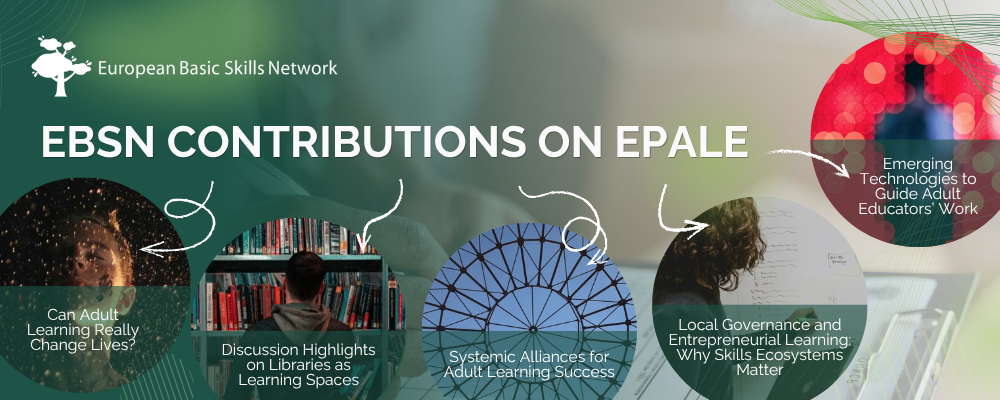
Over recent months, EBSN has contributed a series of articles to EPALE exploring some of the key questions shaping adult learning and basic skills today — from the transformative potential of learning and the importance of inclusive local ecosystems to the changing role of technology in adult education.
Can adult learning really change lives? One of the contributions revisits this fundamental question through perspectives from adult learning theory, highlighting how learning can strengthen agency, confidence, participation and social inclusion far beyond the acquisition of qualifications. Another article turns to libraries as innovative learning spaces, showing how trusted community institutions can support basic skills, digital inclusion, participation and lifelong learning, particularly for adults who may feel distant from formal education.
The importance of the wider environment surrounding adult learners is explored further in two contributions on partnerships and skills ecosystems. Systemic Alliances for Adult Learning Success looks at how cooperation between learning providers, employers, public authorities, social partners, libraries and community organisations can help overcome barriers to participation and create more responsive learning pathways. Local Governance and Entrepreneurial Learning: Why Skills Ecosystems Matter broadens this perspective by considering how local governance, entrepreneurial competences and stronger links between education and employment can support adults navigating changing labour markets and increasingly non-linear careers.
The most recent contribution focuses on emerging technologies and the work of adult educators. It brings together practical approaches from the ETHLAE project, the professionalisation work of the Swiss-Hungarian ProfAdul initiative and recent OECD thinking on artificial intelligence in vocational education and training. A common message runs through these examples: digital tools and AI can create real value in adult learning when they strengthen, rather than replace, professional judgement, human relationships and learner agency.
Together, these contributions reflect several closely connected priorities for adult basic skills: making learning meaningful and inclusive, strengthening cooperation around learners, creating supportive local learning environments, and helping educators respond critically and confidently to technological change.